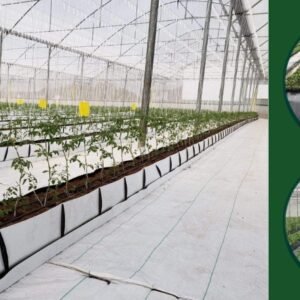
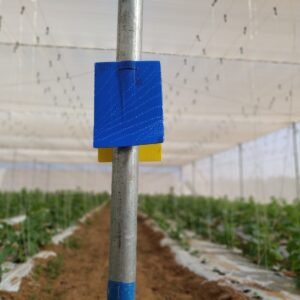
Today, farming is becoming more risky due to unpredictable weather conditions. Farmers face problems like heavy rainfall, drought, pest attacks, and unstable market prices. Because of these challenges, many farmers are shifting towards polyhouse farming in India.
Polyhouse farming is not just a trend, it is a smart farming business model. If you want better income, less risk, and full control over your crop production, then polyhouse farming in India is one of the best options today.
What is Polyhouse Farming
Polyhouse farming is a modern method where crops are grown inside a structured environment made using GI pipes and covered with UV-stabilized plastic sheets.In this system, farmers can control:
- Temperature
- Humidity
- Irrigation
- Sunlight
Because of this control, polyhouse farming offers:
- Better crop quality
- Higher production
- Reduced risk
- Year-round farming
That is why polyhouse farming in India is becoming the future of agriculture.
General Types of Polyhouse Farming
1. Naturally Ventilated Polyhouse (NVPH)
A naturally ventilated polyhouse is one of the best options for farmers who want to start polyhouse farming in India with a simple and low-risk setup.
It works on natural airflow. When the temperature inside increases, hot air automatically rises and goes out through the top vents. At the same time, fresh and cooler air enters from the sides. This natural process (called stack effect and cross ventilation) keeps the inside environment balanced without using electricity.
How it helps in farming:
- Maintains temperature naturally
- Keeps air fresh and controls humidity
- Protects crops from heat, rain, and wind
Why farmers prefer this:
- Easy to manage and maintain
- No electricity cost
- Best choice for beginners
It is ideal for crops like tomato, cucumber, and capsicum, giving stable production with less risk. It can also support advanced methods like hydroponics farming.
2. Fan-Pad Polyhouse (Climate Controlled)
A fan-pad polyhouse is a more advanced system where the environment is controlled using cooling technology.
In this system, fans remove the hot air from inside the polyhouse. At the same time, outside air passes through wet cooling pads, which cool the air before it enters inside. This keeps the temperature comfortable even during extreme heat conditions.
How it controls the environment:
- Keeps temperature cool even in hot weather
- Maintains proper humidity for better crop growth
- Provides uniform cooling across the polyhouse
Best for farmers who want:
- High-quality and export-level crops
- Full control over crop conditions
- Farming in hot regions like Gujarat and Rajasthan
- Higher income from premium or off-season crops
This type requires higher investment, but it provides better control, consistent production, and higher returns when managed properly. It is also suitable for hydroponics farming.
Benefits of Polyhouse Farming in India
Polyhouse farming in India is becoming popular because it helps farmers earn more while reducing risk. In this system, crops are grown inside a protected structure, so they are safe from heavy rain, strong sunlight, and wind damage.
Farmers can grow high-value crops in polyhouse like capsicum, cucumber, and tomato, which give higher income in the market. With a drip irrigation system in polyhouse, water use is reduced by 40–60%, which saves cost and resources.
Another big benefit of polyhouse farming is better crop quality. Since the environment is controlled, crops look good, grow faster, and get higher prices. Also, farmers can do year-round farming, so they don’t have to depend on seasons and can earn continuously.
Key Benefits
- Grow high-value crops in polyhouse like capsicum, cucumber, tomato
- Protection from weather in polyhouse farming in India
- Save water with drip irrigation system in polyhouse
- Better crop quality and higher price
- Year-round farming and regular income
Profit in Polyhouse Farming
The biggest reason farmers choose polyhouse farming in India is fast income and quick recovery.
In traditional farming, you wait for one season and still face risk. But in polyhouse farming, crops grow faster and start giving returns early, so income begins quickly.
Let’s understand with capsicum farming in polyhouse:
- Production: 26,000 to 28,000 kg
- Market Price: ₹60–₹80/kg
- Total Income: ₹15–₹20 lakh
- Net Profit: ₹9–₹11 lakh per year
👉 Earning starts from the first harvest itself, usually within 50–60 days.
Because of faster crop cycles and better market prices, many farmers are able to recover their investment within 1.5 to 2 years (with proper planning and crop selection).
With polyhouse farming in India:
- Faster crop cycles = quick money flow
- Multiple harvests = regular income
- Better quality = higher selling price
That’s why polyhouse farming is becoming a fast income and high-return farming model for modern farmers.
Government Support (NHB + Agri Infra Fund)
The government helps farmers start polyhouse farming in India by reducing cost and loan burden.
Under NHB (National Horticulture Board):
- You can get up to 50% subsidy on polyhouse cost
- This reduces your starting investment
Under AIF (Agriculture Infrastructure Fund):
- You get 3% interest subsidy on loan
- This makes your loan cheaper and easy to repay
Because of these schemes, starting polyhouse farming becomes more affordable and less risky for farmers.
Step-by-Step Polyhouse Setup & Subsidy Process (India)
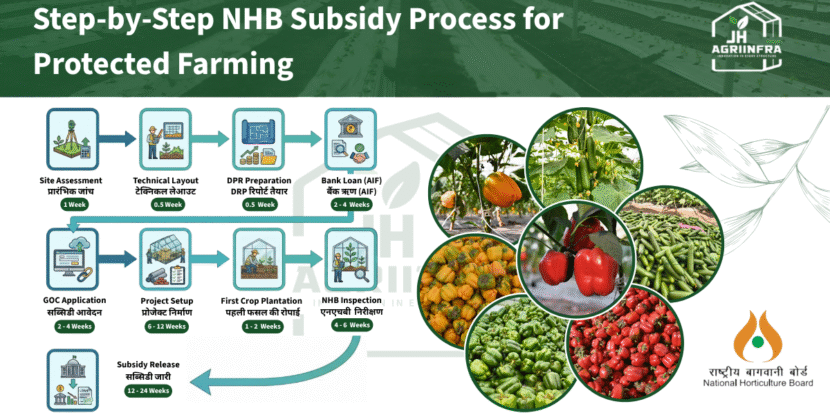
Starting polyhouse farming requires proper planning along with a clear understanding of the subsidy process. Here is a simplified step-by-step guide:
1. Land Selection & Site Assessment
- Select suitable land
- Conduct soil, water, and climate testing
2. Technical Planning & Design
- Customized Structure design according to NHB standards (height, spacing, ventilation, material quality)
- Irrigation and fertigation planning
- 3D layout preparation
3. DPR (Detailed Project Report)
- Project cost estimation
- Crop planning (high-profit crops)
- Income and ROI calculation
4. Bank Loan & Financial Approval
- Apply for bank loan (AIF or other schemes)
- Get project and funding approval
5. Subsidy Application (NHB)
- Apply for GOC (Grant of Certificate)
- Complete documentation and submission
6. Polyhouse Construction & Setup
- Structure installation
- Drip irrigation and fertigation system setup
7. Plantation & Farming Start
- Begin first crop plantation
- Follow scientific farming practices
8. Inspection & Subsidy Release
- Government inspection of the project
- Subsidy amount credited to your account
Outcome
- Structured and professional setup
- Access to subsidy benefits
- Faster return on investment
- Reduced farming risk
How JH Agriinfra Helps You
Starting polyhouse farming becomes easy with JH Agriinfra’s complete support — from planning to profit.
Services Provided:
- Land assessment & feasibility check
- Soil & water testing
- Customized polyhouse design
- 3D layout planning
- Government subsidy & documentation support
- Bank loan/project report assistance
- High-quality material supply (GI structure, polyfilm, nets)
- Drip irrigation & fertigation setup
- Professional installation & turnkey execution
- Automation & smart farming solutions
Agronomy Support:
- Crop selection (high-profit crops)
- Region-wise crop planning
- Fertilizer & fertigation schedule
- Irrigation management
- Pest & disease control (IPM)
- Farmer training & expert guidance
- Crop cycle management
- Harvesting & post-harvest support
🎯 Result:
✔ Higher yield
✔ Better quality produce
✔ Reduced risk
✔ Faster ROI
Common Mistakes to Avoid
Avoid these mistakes in polyhouse farming:
- Starting without subsidy approval
- Using low-quality material
- Not testing soil & water
- Wrong crop selection
- No market planning
Why Choose JH Agriinfra
Choosing the right partner is very important in polyhouse farming in India. At JH Agriinfra, we focus on real ground-level support, not just construction.
We have experience in handling multiple polyhouse projects across different areas, and we understand the actual challenges farmers face on field. Our approach is simple — clear planning, proper guidance, and long-term support.
- Complete support from planning to installation
- Proper guidance for polyhouse subsidy in India (from start to approval)
- Strong project execution with quality materials
- Experience in handling projects across different regions
- Step-by-step support — land selection, design, setup, and crop start
- Practical guidance based on real farming conditions
- Farmer-first approach with honest and clear communication
Our focus is not only on building a structure, but on helping you start your polyhouse farming journey in a planned and successful way.